Brenat: A Practical Look at Modern Layered Typography
In the crowded landscape of digital typography, finding a typeface that balances aesthetic novelty with functional reliability is often a challenge for designers and content creators. Brenat emerges as a compelling solution in this space, offering a modern layered display font that manages to bridge the gap between sophisticated elegance and contemporary flair. For professionals who rely on visual communication to capture attention, understanding the nuances of such a tool is essential before integrating it into a workflow. This analysis explores the characteristics, practical applications, and strategic value of Brenat, helping you determine if it aligns with your creative objectives.
Understanding the Design Philosophy
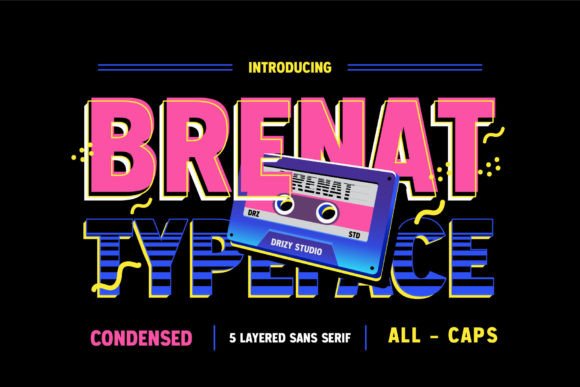
At its core, Brenat is crafted with precision and attention to detail, designed to elevate creative projects through its distinct structural qualities. Unlike standard sans-serif or serif fonts that prioritize invisibility or traditional readability, Brenat is a display font. This classification means it is intended for headlines, titles, logos, and short-form text where impact is paramount. The font’s clean lines and balanced proportions provide a stable foundation, while its unique layering options introduce a dimension of depth that static fonts often lack.
The concept of "layering" in typography allows designers to create complex visual effects by stacking different weights or styles of the same font family. With Brenat, this feature is not an afterthought but a central element of its design. It enables the creation of shadow effects, inline details, and multi-colored compositions without the need for external graphic manipulation. This inherent flexibility makes it a standout choice for applications requiring a high degree of visual customization.
Key Characteristics and Technical Strengths
To evaluate the true utility of Brenat, one must look beyond its initial visual appeal and examine its technical execution. Several key characteristics define its performance in real-world scenarios:
- Versatility in Application: While primarily a display font, Brenat’s clean geometry allows it to perform well in various contexts, from bold poster headers to subtle branding elements. Its adaptability ensures it does not feel out of place in either minimalist or maximalist design schemes.
- Precision Craftsmanship: The balanced proportions of the letterforms ensure that even at larger sizes, the font maintains visual harmony. There are no awkward gaps or inconsistent stroke widths, which speaks to the high quality of its vector construction.
- Contemporary Flair: The font avoids trending gimmicks that may date quickly. Instead, it offers a timeless modernity that feels current yet durable. This is crucial for brands seeking long-term identity consistency.
- Layering Capability: The ability to combine layers effortlessly simplifies the design process. Designers can achieve complex looks directly within their layout software, reducing file complexity and improving workflow efficiency.
Practical Applications for Professionals
Who benefits most from incorporating Brenat into their toolkit? The answer lies in any role where visual hierarchy and brand perception are critical. Marketers, for instance, can leverage Brenat to create eye-catching social media graphics that stop the scroll. The layered effect adds a tactile quality to digital images, making them feel more substantial and engaging.
For entrepreneurs and small business owners, Brenat offers a cost-effective way to achieve a premium look. A well-designed logo or packaging label using this font can convey sophistication without the need for expensive custom illustration. Freelancers and agencies will appreciate the time saved by using a font that comes with built-in stylistic alternatives, allowing for rapid prototyping of concepts.
Educators and publishers might find Brenat useful for chapter headings or cover designs where a touch of personality is required without sacrificing legibility. However, it is important to note that as a display font, it is not suited for long bodies of text. Its strength lies in brevity and impact, not in extended reading experiences.
Evaluating Usability and Workflow Integration
From a usability standpoint, Brenat integrates smoothly into standard design environments. Whether you are working in Adobe Illustrator, Photoshop, or web-based design tools, the font files are optimized for stability. The layering options are typically accessible through OpenType features or by manually stacking provided font variants, giving designers control over the final output.
One of the significant advantages of Brenat is its consistency. When working on large-scale projects, such as a brand rollout or a series of promotional materials, maintaining a cohesive visual language is vital. Brenat’s uniform stroke weight and predictable spacing ensure that every application of the font feels part of the same family. This reliability reduces the cognitive load on designers, allowing them to focus on broader creative strategies rather than fixing typographic inconsistencies.
Furthermore, the font’s flexibility extends to color usage. Because the layers are distinct, designers can experiment with contrasting colors to highlight specific parts of a word or phrase. This technique is particularly effective in digital advertising, where color psychology plays a significant role in user engagement.
Considerations and Limitations
While Brenat offers numerous strengths, it is essential to approach its use with a clear understanding of its limitations. As with any display typeface, legibility decreases as the text size reduces. Using Brenat for subheadings or body copy may result in a cluttered appearance, especially on smaller screens. Therefore, it should be paired with a highly readable sans-serif or serif font for supporting text.
Additionally, the layered effect, while visually striking, can become overwhelming if overused. Best practices suggest using the full layered complexity for primary headlines and opting for simpler, single-layer versions for secondary elements. This hierarchy ensures that the design remains breathable and focused.
Another consideration is the context of the brand. Brenat’s sophisticated and contemporary nature may not align with brands aiming for a rustic, hand-drawn, or ultra-traditional aesthetic. It thrives in environments that value modernity, clarity, and refined design. Understanding your target audience’s preferences is crucial before committing to this typeface.
Long-Term Value and Strategic Fit
Investing in a quality typeface like Brenat is not just about immediate aesthetic improvement; it is about long-term brand equity. A distinctive font can become a recognizable asset, contributing to brand recall and identity. Because Brenat avoids fleeting trends in favor of balanced, clean design, it is likely to remain relevant for years. This durability offers excellent return on investment for businesses and creators who plan to use the font across multiple campaigns and platforms.
Moreover, the versatility of Brenat means it can grow with your project. As your needs evolve from simple social posts to comprehensive brand guidelines, the font’s range of styles and layering options provides the necessary depth to support that growth. It is a tool that encourages experimentation while maintaining a professional standard.
Final Thoughts on Choosing Brenat
In conclusion, Brenat represents a thoughtful addition to the modern designer’s toolkit. It successfully combines sophistication with contemporary flair, offering a versatile solution for those looking to elevate their visual communication. Its clean lines, balanced proportions, and innovative layering options make it a powerful asset for headlines, logos, and branding materials.
For professionals, entrepreneurs, and creators who value precision and flexibility, Brenat delivers on its promise. It is not merely a decorative element but a functional tool that enhances clarity and impact when used appropriately. By understanding its strengths and respecting its limitations, you can harness its potential to create compelling, memorable designs that resonate with your audience. If your goal is to project a modern, polished image with a touch of unique character, Brenat is certainly worth considering for your next project.