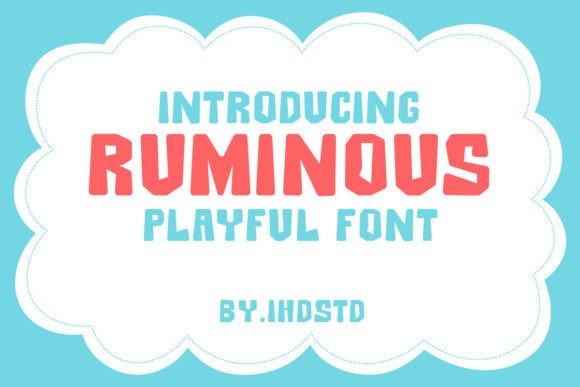
Ruminous: Evaluating a Playful Typeface for Modern Design Projects
In the crowded landscape of digital typography, finding a typeface that balances personality with legibility is a persistent challenge for designers. Ruminous emerges as a distinct option in this space, positioning itself not merely as a decorative element but as a functional tool for adding character to visual communication. As an effervescent and playful font, it offers a specific aesthetic that diverges from the rigid structures of traditional sans-serifs or the formal elegance of classic serifs. For professionals ranging from freelance graphic designers to small business owners, understanding the practical applications and limitations of such a specialized typeface is essential before integrating it into a brand identity or marketing campaign.
Defining the Aesthetic and Core Characteristics
Ruminous is best described as a display typeface with a hand-crafted sensibility. Its primary characteristic is its ability to breathe life into static designs through irregular strokes, rounded terminals, and a dynamic baseline that suggests movement. Unlike geometric fonts that prioritize uniformity, Ruminous embraces a degree of organic imperfection. This "enchanting flair," as often noted in typographic reviews, stems from its deliberate departure from mechanical precision. The letters possess a buoyant quality, making them appear light and approachable rather than heavy or authoritative.
The font’s structure is purposefully crafted to dazzle in large formats. When viewed at poster sizes, the nuances of the letterforms become apparent, allowing the typography to serve as both text and image. This dual function is critical for modern design, where attention spans are short and visual impact is paramount. The playful nature of Ruminous does not imply a lack of sophistication; rather, it reflects a contemporary trend towards human-centric design that values warmth and accessibility over cold minimalism.
Practical Applications in Marketing and Branding
The versatility of Ruminous extends across several key areas of graphic design, though its effectiveness varies depending on the medium. One of its strongest use cases is in poster design. Here, the font’s unique style can anchor a composition, drawing the eye immediately to the headline. Whether promoting a local music festival, a community event, or a creative workshop, Ruminous provides the visual energy necessary to stand out in a busy physical or digital environment.
Beyond posters, the font adds significant value to logo design for brands targeting a younger or more casual demographic. Startups in the lifestyle, food and beverage, or creative education sectors may find that Ruminous helps communicate a friendly and innovative brand personality. However, it is crucial to note that this font is less suitable for corporate entities requiring an image of strict reliability or traditional stability. The context of the brand must align with the font’s inherent playfulness.
Another practical application is in the creation of stickers and merchandise. The rounded, cohesive shapes of the letters translate well to die-cut formats, where clarity and recognizability are key. Similarly, when applied to jerseys or apparel, Ruminous can create a sense of team spirit or casual coolness that more formal fonts cannot achieve. For invitation cards, particularly for birthdays, baby showers, or informal gatherings, the font’s enchanting quality sets the appropriate tone of celebration and ease.
Usability and Integration in Print Media
While Ruminous excels in display settings, its role in longer-form print media requires careful consideration. Using it to accentuate brochures is a viable strategy, but only if employed sparingly. In a brochure layout, Ruminous should be reserved for headers, subheads, or pull quotes. Using it for body text would likely compromise readability due to its irregular stroke widths and playful distortions. The goal is to use the font to break up monotony and guide the reader’s eye, not to exhaust them.
Designers must also consider the technical aspects of printing. The fine details and effervescent qualities of Ruminous require high-resolution output to maintain their integrity. On low-quality paper or with poor printing techniques, the delicate features may blur, reducing the font’s impact. Therefore, when planning projects involving this typeface, ensuring high-quality production values is a non-negotiable aspect of maintaining professional standards.
Target Audience and Strategic Fit
Who benefits most from incorporating Ruminous into their workflow? The primary users are likely to be creative freelancers and marketing professionals who need to produce engaging content quickly without sacrificing uniqueness. For bloggers and publishers, using Ruminous in featured images or social media graphics can increase click-through rates by offering a fresh visual alternative to standard stock typography. Educators and creators of learning materials may also find value in its approachable style, which can make educational content feel less intimidating and more engaging for students.
Small business owners, particularly those in creative industries, can leverage Ruminous to differentiate their visual identity from competitors who may rely on generic, safe font choices. By adopting a typeface with such a distinct personality, these businesses signal creativity and confidence. However, it is important for these users to understand that a font like Ruminous works best as part of a broader design system. It should be paired with a neutral, highly legible sans-serif for body text to create balance and ensure that the overall message remains clear.
Evaluating Long-Term Value and Limitations
When assessing the long-term value of Ruminous, one must consider its timelessness versus its trendiness. While playful fonts have seen a resurgence in recent years, the specific stylistic choices of Ruminous are grounded in a classic hand-drawn aesthetic that tends to age better than ultra-modern experimental typefaces. This suggests that investments in branding using this font may remain relevant for several years, provided the surrounding design elements are kept clean and contemporary.
However, there are limitations. The font’s strong personality means it can easily overpower other design elements if not used with restraint. It lacks the neutrality required for complex data visualization or dense informational layouts. Furthermore, because it is a display font, it may not offer the extensive weight variations (such as light, regular, bold, black) found in comprehensive font families. This limits its flexibility in hierarchical design systems where multiple levels of emphasis are needed within the same typeface family.
Reliability in cross-platform usage is another factor. Designers should test Ruminous across various devices and operating systems to ensure consistent rendering. While modern web fonts have improved significantly, subtle differences in anti-aliasing can affect the perceived quality of detailed typefaces. Ensuring that the font loads correctly and maintains its intended shape on mobile devices is a critical step in any digital implementation.
Final Recommendations for Effective Use
To maximize the effectiveness of Ruminous, designers should adhere to a few key principles. First, prioritize whitespace. The playful nature of the font needs room to breathe; crowding it with other elements diminishes its impact. Second, use color strategically. Bright, vibrant colors often complement the effervescent quality of the letters, while muted tones can soften the effect for more sophisticated applications. Third, always pair it with a contrasting typeface. A clean, geometric sans-serif provides the necessary structural support that allows Ruminous to shine without causing visual chaos.
In conclusion, Ruminous is a valuable asset for designers seeking to inject personality and warmth into their projects. It is not a universal solution for all typographic needs, but for specific applications such as posters, logos, and invitations, it offers a compelling blend of charm and professionalism. By understanding its strengths and respecting its limitations, creative professionals can use Ruminous to create memorable and effective visual communications that resonate with their target audiences. The key lies in thoughtful integration, ensuring that the font serves the message rather than distracting from it.