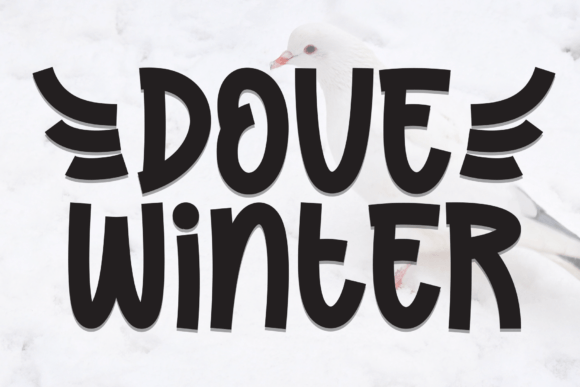
Dove Winter: Evaluating a Handwritten Display Font for Creative Projects
In the vast landscape of digital typography, finding a typeface that balances personality with legibility can be a challenging endeavor. Designers and hobbyists alike often seek fonts that convey specific emotional tones without sacrificing readability. Dove Winter emerges as a notable option in this category, positioned as a handwritten display font characterized by its sweet and friendly aesthetic. This article explores the characteristics of Dove Winter, examining where it excels, where it may fall short, and how it fits into broader design strategies.
Understanding the Aesthetic of Dove Winter
Dove Winter is designed to mimic the natural flow of handwriting, offering an organic feel that rigid, geometric sans-serifs often lack. Its primary visual traits include rounded terminals, consistent stroke weights, and a playful baseline that suggests movement. The font is described as delightful and brimming with friendliness, qualities that are immediately apparent upon first glance. Unlike formal script fonts that prioritize elegance and tradition, Dove Winter leans into an approachable, casual vibe.
The "handwritten" aspect is crucial here. It does not attempt to replicate perfect calligraphy but rather the charming imperfections of human penmanship. This makes it particularly effective for projects aiming to establish a personal connection with the audience. When evaluating this font, it is important to recognize that its strength lies in its ability to soften the visual tone of a composition, making it feel less corporate and more intimate.
Ideal Use Cases and Applications
One of the most significant factors in selecting a typeface is context. Dove Winter is explicitly marketed toward compositions that require a sprinkle of fun and warmth. Based on its design attributes, several specific applications stand out as strong fits:
- Wedding Invitations: For couples seeking a relaxed, modern, or rustic theme, Dove Winter can serve as an excellent choice for headers or names. It avoids the stiffness of traditional serif fonts while maintaining enough structure to remain readable.
- Greeting Cards: Whether for birthdays, holidays, or thank-you notes, the font’s adorable nature aligns well with the sentimental purpose of these items. It enhances the message by adding a layer of personal touch.
- Branding for Lifestyle Businesses: Small businesses in sectors such as baking, childcare, pet care, or handmade crafts often benefit from typography that feels welcoming. Dove Winter can help these brands communicate approachability.
- Social Media Graphics: In digital spaces where attention spans are short, a friendly font can increase engagement. It works well for quote overlays or promotional banners that aim to feel authentic rather than polished.
In these scenarios, the font transforms regular text into an enchanting narrative, supporting the overall mood of the design rather than competing with it.
Benefits and Practical Advantages
Choosing Dove Winter offers several practical benefits for designers. First, its legibility is generally higher than many complex script fonts. While it is decorative, the letterforms are distinct enough to be read quickly, which is essential for invitations and cards where information must be conveyed clearly. Second, its versatility within the "casual" niche allows it to pair well with a variety of secondary fonts. It often works harmoniously with simple sans-serif body text, creating a balanced hierarchy where Dove Winter handles the emphasis and a neutral font handles the details.
Furthermore, the emotional resonance of the font cannot be overstated. In design psychology, rounded shapes are often associated with safety and comfort. By utilizing Dove Winter, designers can subtly influence the viewer’s perception, making the content feel safer and more inviting. This is particularly valuable in industries where trust and warmth are paramount.
Tradeoffs and Limitations
Despite its charms, Dove Winter is not a universal solution. Understanding its limitations is critical for making an informed decision. As a display font, it is not intended for long-form body text. Using it for paragraphs or dense information blocks will likely result in reader fatigue due to the irregular spacing and stylistic flourishes. It is best reserved for headlines, titles, and short phrases.
Additionally, the "playful" nature of the font may clash with serious or formal contexts. For legal documents, corporate annual reports, or high-end luxury branding that relies on exclusivity and distance, Dove Winter may appear too informal or juvenile. Designers must carefully assess the brand voice before implementation. If the goal is to project authority, precision, or minimalism, this font’s friendly demeanor could undermine the intended message.
Another consideration is scalability. While it performs well at medium to large sizes, intricate details in handwritten fonts can sometimes blur or lose definition when scaled down significantly for small print items like business cards or footnotes. Testing the font at the intended output size is a necessary step in the workflow.
Comparing Alternatives
When evaluating Dove Winter, it is helpful to consider what alternatives might offer. If a project requires a similar handwritten feel but with more formality, a traditional script font might be a better choice. Conversely, if the goal is maximum readability with a hint of personality, a rounded sans-serif font could provide a cleaner look while still feeling friendly.
Designers should also consider the saturation of the market. Handwritten fonts are abundant, and distinguishing one from another can be difficult. Dove Winter stands out due to its specific balance of sweetness and clarity, but it is essential to ensure it does not look too similar to competitors’ branding. Customization options, such as adjusting tracking or combining with unique graphic elements, can help mitigate this risk.
Decision-Making Insights for Designers
To determine if Dove Winter aligns with your goals, ask the following questions:
- What is the primary emotion I want to evoke? If the answer is warmth, joy, or intimacy, this font is a strong candidate. If the answer is seriousness or luxury, look elsewhere.
- How much text needs to be displayed? Keep usage to short bursts. If you need to write paragraphs, reserve Dove Winter for headings only.
- Who is the target audience? Younger demographics or families may respond more positively to this style than older, more conservative audiences.
- Does it pair well with existing assets? Test the font alongside your color palette and imagery. Its light and airy nature often complements pastels and soft photography but may get lost against dark, heavy backgrounds.
Ultimately, Dove Winter is a specialized tool. It excels in creating a specific atmosphere—one that is delightfully sweet and brimming with friendliness. By understanding its strengths and respecting its limitations, designers can leverage this font to enhance wedding invitations, greeting cards, and other creative projects effectively. It is not merely about choosing a pretty typeface; it is about selecting the right voice for your visual narrative. When used thoughtfully, Dove Winter can transform ordinary text into an engaging and memorable experience, fulfilling the desire for designs that feel both personal and professional.